Structural Determinants of Health
Food Access · Chronic Disease Prevention · Gender Equity
Produce Perks: SNAP Nutrition Incentive Evaluation
Produce Perks is Ohio's flagship nutrition incentive program, providing a dollar-for-dollar SNAP match on fresh fruits and vegetables at farmers' markets and grocery stores statewide. Operating across over 100 locations in six Ohio counties, the program reaches SNAP-eligible shoppers where they already shop: neighborhood grocery stores and community farmers' markets.
Through community-led research, mixed-methods inquiry, and grassroots partnerships, my team and I listened directly to the people the program serves—SNAP recipients, retail workers, and store owners—to understand what's working, what barriers remain, and how to strengthen implementation. We pivoted from in-person to virtual data collection during COVID-19, maintaining research rigor while deepening community engagement through innovative remote methods.
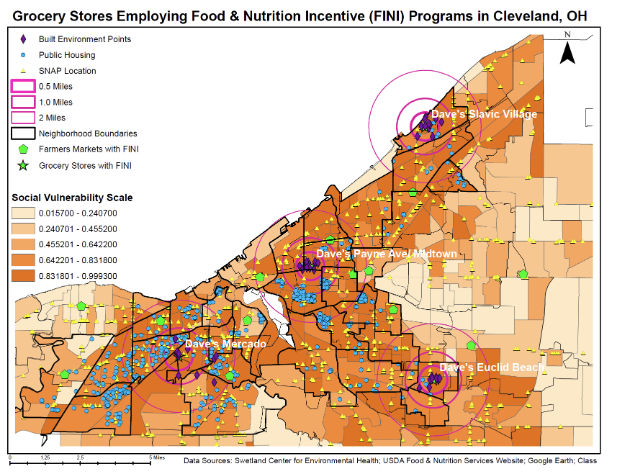
Geographic Reach
Grocery stores employing Food & Nutrition Incentive (FINI) programs across the Cleveland metro area, overlaid with food insecurity data by census tract. Incentive programming varies by store capacity, produce availability, and point-of-sale technology.
Key Leverage Points
Grocery Store Solutions
- Incentivize cashiers
- Effective in-store marketing
- Promotional cards in grocery bags
- POS integration
- Ongoing staff training
Cashier Burden
- No financial gain or benefit
- No incentive to promote the program
- Most effective method to increase customer awareness
Community Solutions
- Collaboration through trusted organizations (Food Pantries, Employment Office, WIC, Health Clinics)
- Nutrition promotion (SNAP-Ed, WIC)
Teen Lifestyle Balance: Diabetes Prevention
The Group Lifestyle Balance™ Program was developed at the University of Pittsburgh as an evidence-based intervention for overweight adults at risk for type 2 diabetes. This project adapted that proven adult program for a younger population: overweight and obese adolescents. Piloted at the Palo Alto Medical Foundation Research Institute, the Teen Lifestyle Balance program aimed to adapt the curriculum for teenagers and identify the most effective delivery method for this patient population.
By combining direct feedback from teens and parents, systematic usability testing of technology platforms, and iterative qualitative analysis, we created an adolescent-appropriate, evidence-informed intervention ready for broader implementation.
Usability Testing
Tested fitness & food tracking apps with adolescents to assess ease of daily use
Focus Groups & Interviews
Teens and parents on barriers, motivations, and preferences for program delivery
Qualitative Analysis
Thematic coding in Dedoose; Excel matrices organized by age, gender, demographics
Curriculum Adaptation
Simplified language, teen-relevant examples, social media & body image modules
Key Insights
Food tracking apps were overwhelming for adolescents—the database size, terminology, and granularity created barriers, and simpler visual tools were strongly preferred. Teens were motivated by social connection and feeling good, not just weight loss or disease risk reduction. Parental involvement proved essential: family meal patterns and food purchasing decisions heavily shaped adolescent behavior change. A hybrid delivery model combining in-person group sessions with telehealth was preferred, providing peer connection while accommodating busy schedules.
Gender Inequality in Tibetan Buddhism
In Tibetan Buddhism, the word for nun—"skye dman"—literally translates to "inferior birth." Many nuns spend decades practicing dharma and accumulating good karma in the hope of being reborn as male in their next lifetime. This research investigated how this spiritual framework manifests in the daily lived experiences of monks and nuns in contemporary Himalayan Buddhist institutions, examining what structural barriers in monastic hierarchy, education access, ritual roles, and resource allocation reinforce gender differences.
Hyulsahyong Monastery
Participated in meditation, chanting, and philosophical debates with monks
Nagi Nunnery
Immersive stay with nuns, observing coursework and daily rituals
Kopan Monastery
Attended philosophical debate sessions; in-depth interviews across generations
Khachoe Ghakyil Nunnery
Documented gender dynamics in education access and resource allocation
Methods
I lived with monks and nuns for three-week immersive stays at each institution, participating fully in daily monastic life: meditation sessions beginning at 4 am, chanting rituals, prayer ceremonies, and work assignments. I attended philosophical debate sessions central to Tibetan Buddhist intellectual culture, and conducted formal in-depth interviews with practitioners spanning from recent initiates to those with 30+ years of monastic experience. Much of the richest data came from informal conversations—while cooking, walking to the village, or sitting in the courtyard—moments that revealed tensions and unspoken rules that didn't surface in formal settings.
Key Findings
Access to advanced philosophical training differed sharply by gender, limiting nuns' scholarly authority even when they had equivalent training. Certain ceremonies and leadership roles remained reserved for monks. Resource allocation reflected this hierarchy: monks' monasteries tended to have larger libraries, more funding, and better living conditions. Yet nuns were actively creating change—establishing formal debate sessions, creating female-led study groups, and pushing for greater access to advanced teachings. Some explicitly rejected the aspiration to be reborn male, asserting that female embodiment is not inherently inferior.
Dissemination
Findings were presented at the Atlantic Coast Conference Meeting of the Minds, the Society for Applied Anthropology annual conference, and the WFU Women's & Gender Symposium.
Get in Touch
Interested in connecting about research, collaboration, or community-engaged approaches to health equity? I'd love to hear from you.
© 2026 Alisha Giri